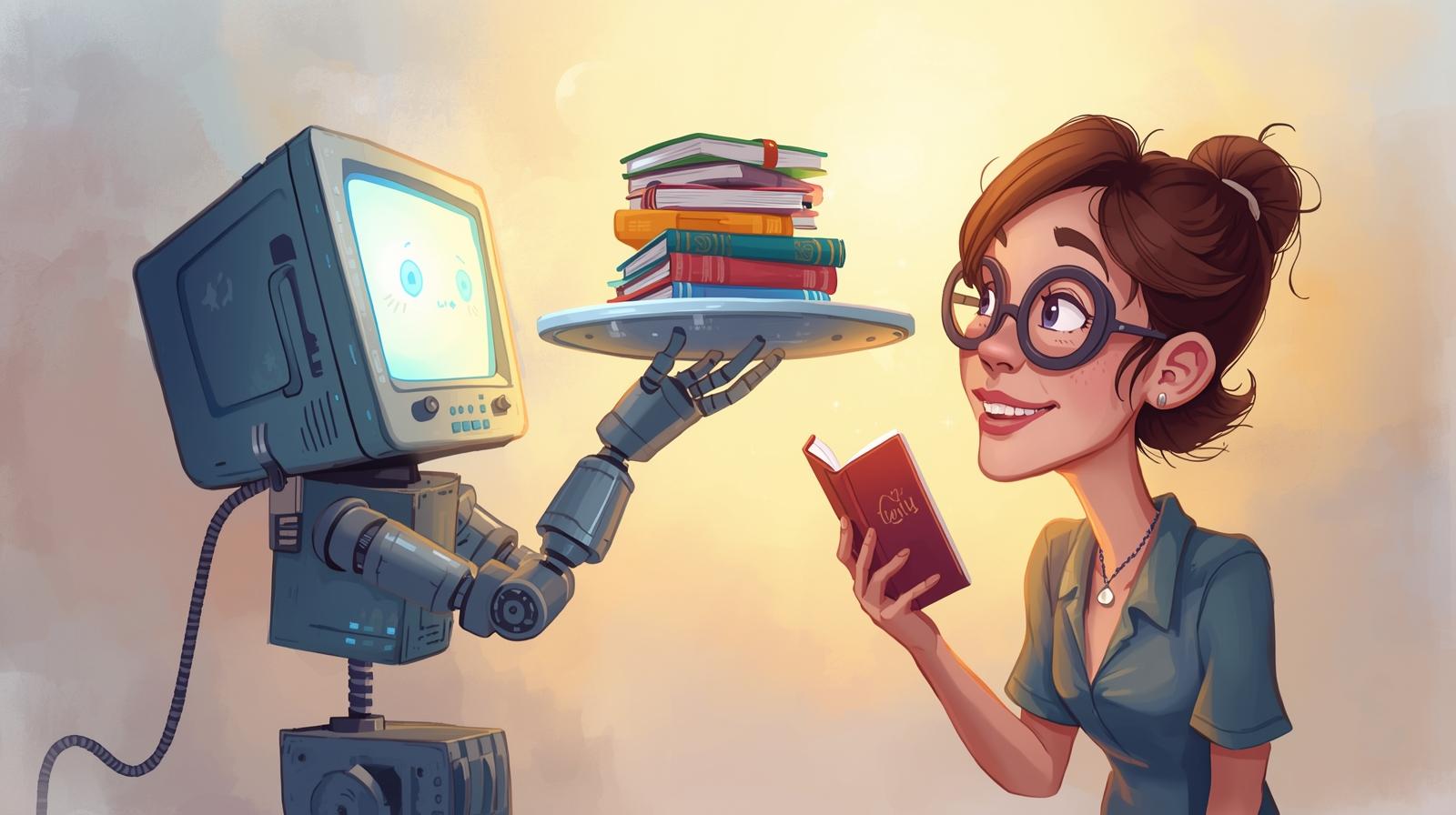
Let AI Do the Heavy Knowledge Lifting

Much has been written about the avalanche of AI bombarding our engagement in the digital realm. For instance, copywriters and editors on LinkedIn lament the myth that an em-dash means “AI did it.” YouTube videos and podcasts [1,2] are helping viewers recognise when “AI did it.”

Bloggers draw attention to the AI-slop served up in the marketing world [3], and those who work online express irritation about how intrusive it is, with a “How can I help you?” at every click. Now Firefox has “Kit.”  

So, what does AI like ChatGPT do? Basically, it gathers information from a very large digital data pool (very quickly) and synthesises that encoded information for a purpose. However, its purpose rests with the instruction given or the question asked. So, bullshit in, bullshit out: I learned that in the very early 1980s when processing survey data in a corporate environment.

AI’s capacity to synthesise information is incredible, but its thinking process, the putting together of that information, is purely (and only) rational. AI does not have “ah hah” moments, flashes of brilliance, creative spurts, or a sense of wonder when patterns are recognised. These non-rational thinking processes have generated some of the most outstanding art and scientific breakthroughs. For example, chemist August Kekulé dreamed of a snake biting its tail, which led to the understanding of the benzene molecule’s cyclic structure [4], René Descartes imagined the world as a grand machine, laying the groundwork for machine consciousness [5]. 

AI is also not inspired by angels, nor does it struggle with demons. Nor does AI respond with its instincts, as do all flesh and blood creatures. AI is a machine; non-rational and irrational thinking processes are exclusively human in comparison.

So, considering that the various types of knowledge, 14 according to some [6], can be loosely categorised as personal, social, and digital, we know the following: First, AI has no access at all to the personal level. Even if it collects your health data via your smartwatch, it is data, and data is always second-hand. Second, the knowledge we share about our experiences is already detached when it is encoded with language (words, numbers, symbols, images) to become social knowledge. Then AI must digitalise that second-hand, social knowledge, making what it spits out third-hand information. Third, AI is limited with respect to its thinking process. It is incapable of being unpredictable, following a hunch, or taking an imaginative leap: Those are human strengths.

So, let AI do the heavy knowledge lifting with its logical, systematic, and methodical processes and instead focus on the blessing of being human: unpredictable, gutsy, and imaginative.

  1. NOVA PBS Official. (2025, Oct. 12) How to Detect Deepfakes: The Science of Recognizing AI Generated Content.  https://www.youtube.com/watch?v=GMoOCKkcd_w,
  2. NOVA PBS Official. (2025, Aug. 26). The Deepfake Detective | Particles of Thought. https://www.youtube.com/watch?v=nG2_GhNdTek
  3. Robinson, Stephan. (2025, Oct. 21). AI Slop is Creating New Freelance Work: Why Businesses Still Need Human Experts in 2025. https://www.peopleperhour.com/discover/guides/ai-slop-is-creating-new-freelance-work-why-businesses-still-need-human-experts-in-2025/
  4. Read, John (1957). From Alchemy to Chemistry. Courier Corporation.  
  5. Sanderson, Daniel. (2025, Oct. 11). The Role of Imagination in Scientific Hypotheses and Memory and Imagination. https://www.planksip.org/the-role-of-imagination-in-scientific-hypothesis-and-memory-and-imagination-1760233400612/
  6. Drew, C. (2023, March 2). The 14 Types of Knowledge. https://helpfulprofessor.com/types-of-knowledge/

Identifying the Two-Dimensional Monotone Monologue of Artificial Intelligence

Hany Farid, an expert in identifying deepfakes, or AI-generated footage of events that have never occurred, claims that human beings can correctly recognize AI-audio just slightly more than chance [1,2]. That sure makes our responses to what we hear and see on social media and professional platforms important: Arguably, madness is a product of responding to what is not real.

Farid’s tools for identification are primarily technical. He uses machines (computers) to do it, but there are other ways of figuring out if what you are seeing and hearing is AI-generated.

Unlike machine consciousness, human consciousness is sensual: we inhabit a meat suit and gather data through it. Two senses are essential for sifting authentic content from AI content. First, the voice of AI-generated content has a particular scripted tone—a tone that transfers even into the academic works/self-help books I edit.

Then there are visual clues—an overly dramatic edge, five fingers and a thumb, shadows that contradict (or none), limbs that come out of or disappear into other objects. As AI is improved and the pixel arrangements become more seamless, the visual clues will become less evident.

A third helpful sense for differentiating authentic footage from AI-generated footage is what some call intuition, a flexible, non-rational experience-based insight [3]. I call the latter soul. If you tune into what you see with your soul, you can feel the soul or absence of it in what is presented. AI generates a deadness. Even when the creator tries to animate what AI produces, it comes across as a two-dimensional monotone monologue with no spark of life behind it. Inevitably, intelligent human beings are going to grow tired of what Stephen Robinson calls AI-slop, or “the flood of low-quality AI outputs that look convincing at first glance but miss the mark in accuracy, tone, usability, or brand fit” [4].   

Of course, AI is not all bad. It is a blessing when one wants to check a fact or definition, find an answer to a quick question, or is gathering and synthesizing information. On social media, sometimes a story is told that tugs at the heart, and your heart might just open. But AI is not going to save us from anything except the heavy lifting or replace jobs except for those held by bureaucrats and call-centre staff. The world is full of forms to complete and chatbots helping one do it.  

Still, it is time to see AI for what it is: a machine, a tool that echoes what has been put into language and published digitally by the collective of human consciousness. Essentially, AI has no access to what is. It cannot access the messiness of being in a body and rubbing shoulders with others. It only has access to the experiences that human beings put into language. Its condition for existence is “data.” Data is always second-hand.

But most important of all, remember AI will never enjoy those non-rational moments of insight that expand human consciousness.

  1. NOVA PBS Official. (2025, Oct. 12) How to Detect Deepfakes: The Science of Recognizing AI Generated Content.  https://www.youtube.com/watch?v=GMoOCKkcd_w,
  2. NOVA PBS Official. (2025, Aug. 26). The Deepfake Detective | Particles of Thought. https://www.youtube.com/watch?v=nG2_GhNdTek
  3. Rephrasely Media. (2023, Jan. 15). Instinct vs. Intuition. https://rephrasely.com/usage/instinct-vs-intuition
  4. Robinson, Stephan. (2025, Oct. 21). “AI Slop is Creating New Freelance Work: Why Businesses Still Need Human Experts in 2025. https://www.peopleperhour.com/discover/guides/ai-slop-is-creating-new-freelance-work-why-businesses-still-need-human-experts-in-2025/

Turnitin Terrors!

As an editor for academics, postgraduates, and nonfiction writers, I was given the opportunity in the last couple of months to see just how unreliable and terrifying Turnitin is. For those who don’t know, Turnitin is a standard plagiarism detector that many academic institutions use to measure the extent to which a writer has presented a published author’s work as their own.

When I majored in Anthropology in the early 80s, it was more than four words in a row; now, it is five. Some institutions choose a 10% similarity score, others 12%. These are arbitrary measures.

Witness This

The candidate did her first submission to Turnitin. The similarity score was 9%, acceptable for that institution, but there were swathes of text in a meticulously constructed 200-page literature review of already-developed models and frameworks that were flagged. As her editor, I supported her decision to rework some of those passages, and she did. To our surprise, the percentage went up 4%―beyond what was acceptable to the institution.

Intrigued, I compared the two reports. In the second report, pages and pages that were not flagged before were flagged. Most intriguing was the flagging of the opening sentence in the first report, but the same sentence in the second report was not. Whereas in the first report, literally nothing in the methodology chapter was flagged, in the second, passages were flagged, especially the section on sampling. There are only so many ways one can explain the difference between probability and non-probability sampling before one runs out of options. More intriguing still was that the research objectives and questions were flagged, as well as some verbatim interviews with participants and arbitrary phrases like “in Table 5.3.”

I wondered, “Has someone published her work in the month we have been working on it?” With the third report, at the eleventh hour, we managed to get the similarity score down to 10%—the very edge of submissability for that institution.

The arbitrariness of the measure (five words) and the percentage permitted is just part of the problem.

How many ways can a standard research claim be made?

First, it is easy to present five words in a row that are written in the same order as a published author because of how English is structured. Consider, for example, research report statements like, “A qualitative phenomenological approach was used in this study.” I suppose one can replace “used” with “applied” or “employed,” or start with an introductory phrase, “in this study,” ” but I know those have been used in numerous research reports because I have edited literally hundreds of research reports over the last 20 years, and there are not hundreds of ways to disclose the approach employed.

Second, due to the “publish or perish” mentality in academic contexts, so much has been published about so many topics in so many fields that any possible way to phrase the same ideas and link them has been used up. There is no new way of conveying your ideas and findings without being flagged by Turnitin, especially in a literature review. If a writer is looking to do an overview of a much-written-about field, like stress or leadership, that writer is at a disadvantage because many more published authors have tried to find different ways of saying the same thing. Moreover, in academic research, one is working with constructs and concepts that have been woven into models, frameworks, and theories. How many ways can a list of five components of a model be listed without presenting the list in the same order as an already-published author?

What about Voice and Cadence?

So what makes a formal research report original, rather than stolen? What makes the difference? I would claim it is in the cadence of the voice and the consistency of the cadence, bearing in mind that any writer is influenced by the voice of those they read.

Cadence is a level of language that Turnitin is not tuned into. And the irony? Turnitin is itself an AI program, and generative AI is the biggest plagiariser of all—it steals the content and voice of whatever has ever been published on the Web by anyone you could imagine. How cruel of academia to terrify students with such arbitrary measures of their contribution to knowledge and truth, and even more so, leave it to a machine that has no understanding of voice and how a voice is developed to make that judgment.